Atlas.
People in motion.
40 portraits. Four systems. Atlas ranks first by average score: 78.95 / 80 in this LLM appearance review.
Model labels masked. A shared scoring rubric. Every comparison available below.
Preserving the person.
We compared Atlas, Wan, LongCat, and LTX on 40 synthetic human portraits with varied speech. The review considers likeness, scene fidelity, visual consistency, and mouth appearance. Natural movement matters; a larger mouth opening or more head movement does not automatically mean a better result.
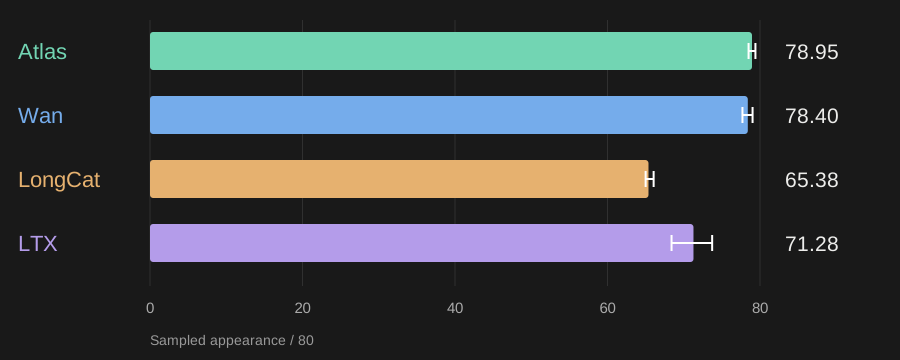
Atlas recorded the highest average score. It scored higher than LongCat on 40 portraits and higher than LTX on 28, with seven ties. Against Wan, Atlas scored higher on 18, tied on eight, and lower on 14.
The details of a convincing face.
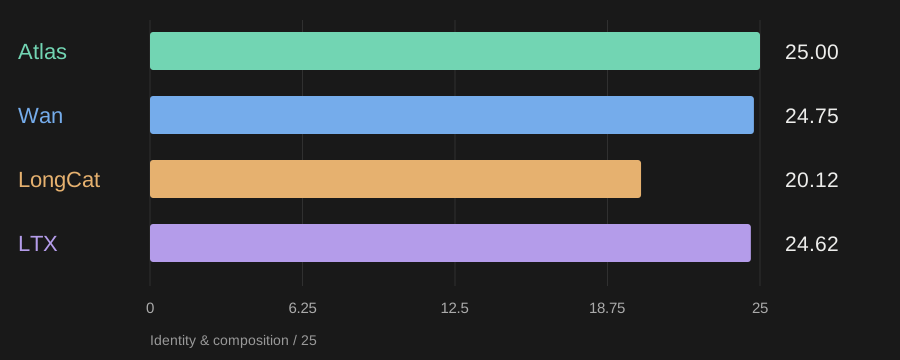
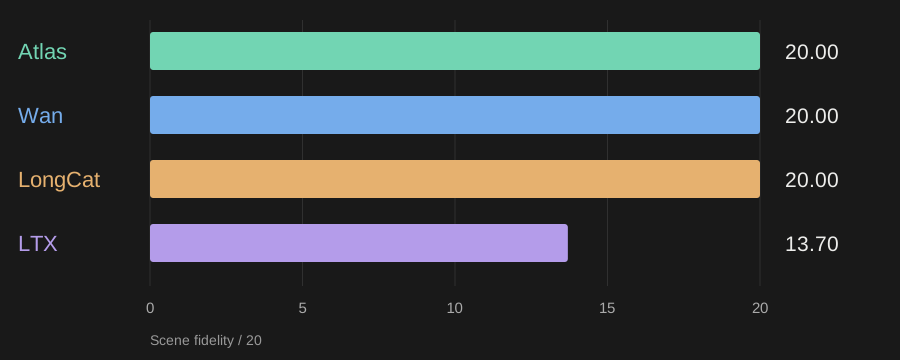
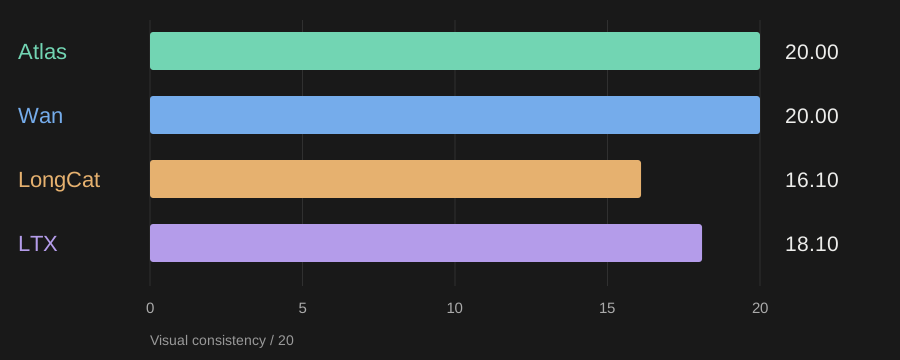
Each category measures a different part of appearance. These scores describe the sampled images; audio synchronization and full-speed motion are not included in these scores. Watch the original videos below to inspect those qualities.
Identity & composition
Scene fidelity
Visual consistency
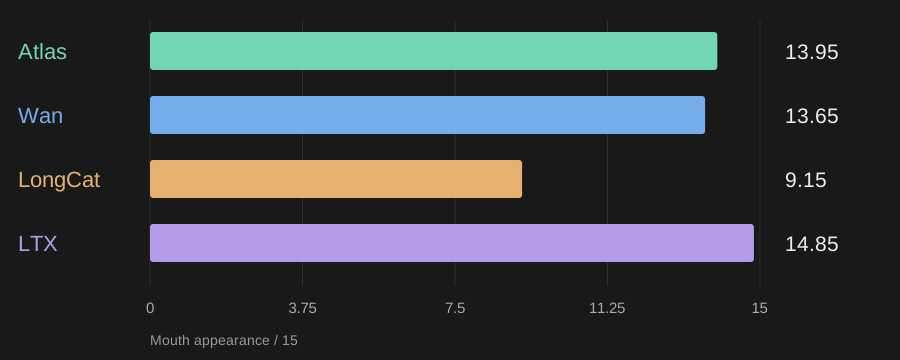
Mouth appearance
Made for conversation.
Atlas recordings were captured through Demo Atlas with audio. Thirty-nine of 40 original recordings delivered at least 22 FPS; the range was 18.70–25.04 FPS. The comparisons below retain each system’s original video and audio timing.
Streaming, without waiting for a finished clip.
Atlas delivered a median 24.46 displayed frames per second in these recordings. Its first rendered speaking frame arrived a median 426 ms after batch submission across 40 session warm-ups. That measures renderer response; input buffering, connection setup, and network playback are outside this latency figure.
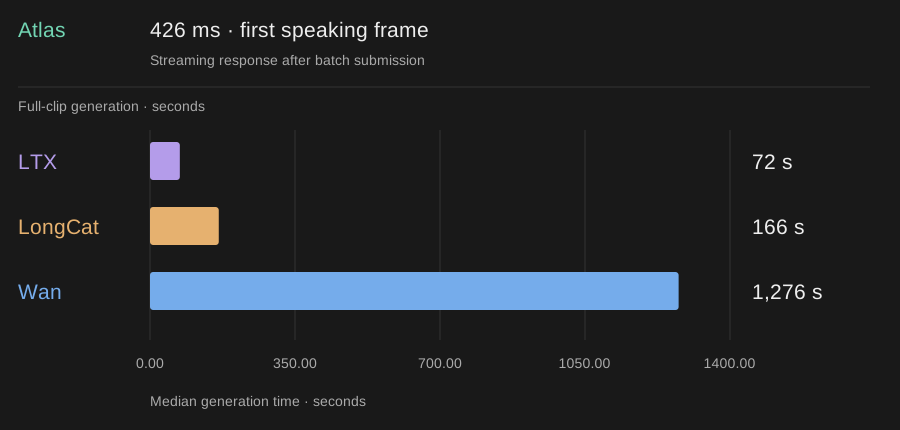
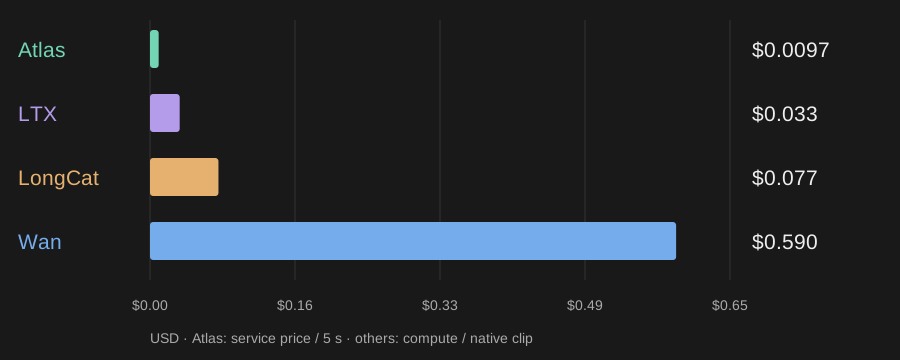
| Model | Generation time | Output length | Generated FPS | Cost / basis |
|---|---|---|---|---|
| Atlas | Streaming · 426 ms first frame | 5 s pricing example | 24.46 displayed | $0.0097 service price · $7/hour |
| LongCat | 166 s | 6.92 s | 1.04 | $0.077 |
| LTX | 72 s | 5.04 s | 1.68 | $0.033 |
| Wan | 1,276 s | 4.81 s | 0.06 | $0.590 |
Generated FPS is the number of output frames divided by generation time, not the clip’s playback frame rate. Atlas’s displayed FPS above measures delivery through Demo Atlas.
These are observed configurations, not equal-hardware speedups: dimensions, settings, and hardware differ. LongCat uses 39 warm runs; its cold first run took 774 seconds. LTX has 39 exact timings; its first run is bounded at 71.23–73 seconds. Wan includes all 40 runs. Cost uses the recorded October 26–27 compute rate of $1.6635/hour for the shared competitor machine.
40 portraits. Four systems.
Compare all 160 videos side by side. Compare from speech onset with Atlas audio, or play the full original recordings.
LLM appearance scores are out of 80. Speech-start playback skips each recording’s measured silent lead-in. It does not align individual words or change the media files.
Portrait 1
algebra tutorAtlas
Review notes
Identity and scene preserved; varied plausible lip shapes.
LongCat
Review notes
Raised chin and widened jaw/lip contours become exaggerated in several samples.
Wan
Review notes
Consistent scene; broad smile and exposed teeth look slightly stylized.
LTX
Review notes
Source-like face and scene; very little articulation visible in these samples.
Portrait 2
language tutorAtlas
Review notes
Stable likeness and background; plausible articulation.
LongCat
Review notes
Several strongly puckered or vertically stretched lip shapes; facial proportions change.
Wan
Review notes
Preserved identity, scene and plausible mouth shapes.
LTX
Review notes
Expressive smile and head tilt remain plausible and preserve likeness.
Portrait 3
science tutorAtlas
Review notes
Stable face and scene; modest plausible articulation.
LongCat
Review notes
Strongly stretched jaw and tooth-bearing mouth shapes alter facial proportions.
Wan
Review notes
Stable source likeness; occasional sharp lip puckering.
LTX
Review notes
Small added ROW label appears beside torso; compressed lips in later samples.
Portrait 4
writing tutorAtlas
Review notes
Consistent face, hair and background; plausible blink and lips.
LongCat
Review notes
Several overextended vertical mouth shapes and chin lifts alter proportions.
Wan
Review notes
Natural articulation with consistent likeness and scene.
LTX
Review notes
Invented glasses and large overlaid text; mouth appearance mostly retained.
Portrait 5
history tutorAtlas
Review notes
Consistent authored face and scene; plausible small lip shapes.
LongCat
Review notes
Cartoon identity retained; some sharply puckered lips.
Wan
Review notes
Likeness recognizable but eye/brow proportions and face shading shift from source.
LTX
Review notes
Face retained; invented white lettering across torso.
Portrait 6
cooking instructorAtlas
Review notes
Beard, likeness and scene retained with plausible articulation.
LongCat
Review notes
Large vertically stretched mouth and chin alter facial proportions.
Wan
Review notes
Source retained; occasional protruding puckered lip shape.
LTX
Review notes
Face retained; repeated invented text across shirt.
Portrait 7
photography instructorAtlas
Review notes
Consistent likeness and plausible mouth contours.
LongCat
Review notes
Jaw and lips strongly distort during puckering and wide-open samples.
Wan
Review notes
Likeness preserved; strongly puckered lips in a few samples.
LTX
Review notes
Added text and cable-like lines across otherwise preserved composition.
Portrait 8
art instructorAtlas
Review notes
Consistent identity and plausible small articulation.
LongCat
Review notes
Broad jaw opening and stretched lip corners alter facial proportions.
Wan
Review notes
Likeness and scene intact; a few puckered lip contours look sharp.
LTX
Review notes
Portrait preserved; little mouth variation visible.
Portrait 9
yoga instructorAtlas
Review notes
Stable likeness and background; plausible lips.
LongCat
Review notes
Strong jaw opening and stretched tooth-bearing mouth alter lower-face shape.
Wan
Review notes
Likeness retained; tooth-bearing shapes slightly exaggerated.
LTX
Review notes
Portrait preserved; faint invented lettering in final sample.
Portrait 10
gardening instructorAtlas
Review notes
Source character and scene retained; plausible articulation.
LongCat
Review notes
Vertical mouth stretching and puckering substantially change lower face.
Wan
Review notes
Expressive head tilt and smile remain consistent with character.
LTX
Review notes
Character retained; added white lettering across torso.
Method.
How we evaluated
Forty AI-generated human portraits span professional and casual settings, mostly realistic with some 3D styles. Each system received the same portrait and speech input for each case: 2.64–3.93 seconds of speech, padded with silence to five seconds. Atlas, Wan 2.2 S2V, LongCat Avatar 1.5, and LTX 2.3 are compared using their saved outputs. The separate long-form review uses fresh, approximately thirty-second scripts on the same portraits.
An LLM evaluator scored ten full frames and ten face crops per video with model labels hidden and positions randomized for each portrait. A fixed audio-activity threshold selected the sampling window, with ten equally spaced sample times. The same sampling rule and scoring anchors applied to every system. Scores were finalized before model identities were revealed; all 40 cases for each of the four models are included.
Each criterion receives an integer rating from one to five: identity and composition (25 points), scene fidelity (20), sampled visual consistency (20), and mouth appearance (15). The weighted total is out of 80. Natural blinks and expressions are allowed; larger movements or greater stillness earn no automatic advantage. Ties are retained.
This is an internal, single-evaluator appearance review; the evaluator had prior project context. It measures sampled appearance, not audible lip-sync or full-speed motion. Intervals use 2,000 paired portrait resamples. Atlas’s +0.55-point difference from Wan has an interval of −0.40 to +1.53. Atlas ranks first by the observed average; the interval does not establish a statistically conclusive lead over Wan.
Videos have different durations and lead-ins. The speech-start comparison seeks each original recording to its measured audio onset; this is approximate onset alignment, not matched phoneme timing. Full-recording playback starts at zero. LongCat’s audio packaging was repaired without changing its video; Wan’s quiet ending is shorter. Playback preserves those differences. Atlas playback copies use MP4 with AAC audio for browser compatibility; the video is not re-encoded and the original recordings are retained. Comparison playback copies also place the MP4 index first for faster loading without re-encoding video or audio. Generation settings and hardware differ, so this is not an equal-hardware speed comparison.