Same faces.
Longer speech.
Forty portraits, each with approximately thirty seconds of fresh continuous speech. 40 of 40 recordings available.
See the results.
Appearance, category scores, generation time and cost. Atlas, Wan, LongCat and LTX across the same forty portraits.
Read the full benchmark →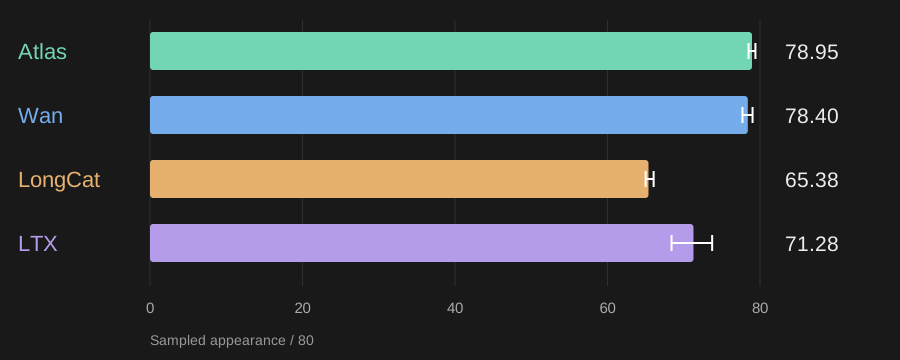
Watch longer conversations.
This Atlas-only test checks whether appearance and motion hold through longer speech. It is separate from the short-form four-model scores. Recordings preserve their audio and quiet endings; completion does not by itself mean a quality pass.
All forty original recordings are available below. Three interrupted captures were retried for technical reasons; the first complete recording is retained for each portrait. Portrait 9 contains a playback pause, marked below.
Portrait 001
algebra tutor · 30.1 s speech
Full recording with original audio. Visual assessment pending.
Spoken script
Let's solve this equation together, step by step. Imagine that three identical boxes and two loose pencils make fourteen pencils altogether. First remove the two loose pencils from both sides. Now divide what remains equally among the three boxes. Substitute your answer into the original equation to check it. There is no need to rush; understanding each part makes the whole process easier. Take a moment to think about that example. Then explain the next step in your own words.
Portrait 002
language tutor · 28.1 s speech
Full recording with original audio. Visual assessment pending.
Spoken script
Say the sentence slowly, then notice how the ending changes. Try describing what you do today, then describe what you did yesterday. Listen for the change in the verb rather than rushing through the sentence. Repeat your example with a different subject, and notice which words stay exactly the same. There is no need to rush; understanding each part makes the whole process easier. Take a moment to think about that example. Then explain the next step in your own words.
Portrait 003
science tutor · 30.0 s speech
Full recording with original audio. Visual assessment pending.
Spoken script
First, predict what happens when we change only this variable. Imagine testing how sunlight affects two seedlings. Give both plants the same soil, water, and container size. Place one near the window and the other farther away. Record what you observe each day before deciding whether your prediction was supported. There is no need to rush; understanding each part makes the whole process easier. Take a moment to think about that example. Then explain the next step in your own words.
Portrait 004
writing tutor · 30.1 s speech
Full recording with original audio. Visual assessment pending.
Spoken script
Your opening works; now give the reader one clear example. Choose a familiar moment, such as waiting for a bus in the rain. Replace a general description with a sound, a small action, and one concrete detail. Read the paragraph aloud and remove any sentence that repeats what readers already understand. There is no need to rush; understanding each part makes the whole process easier. Take a moment to think about that example. Then explain the next step in your own words.
Portrait 005
history tutor · 28.6 s speech
Full recording with original audio. Visual assessment pending.
Spoken script
Connect this event to its causes using the timeline. A useful timeline shows more than dates. Put the major event in the center, then place earlier decisions on one side and later consequences on the other. Distinguish a condition that made change possible from the immediate action that triggered it. There is no need to rush; understanding each part makes the whole process easier. Take a moment to think about that example. Then explain the next step in your own words.
Portrait 006
cooking instructor · 28.8 s speech
Full recording with original audio. Visual assessment pending.
Spoken script
Measure the ingredients first, and keep your workspace tidy. Arrange the bowl, spoon, and measured ingredients before you begin mixing. Read the whole recipe once, including the final step. Add ingredients in the stated order, and use a timer for each stage so you can focus on texture and appearance. There is no need to rush; understanding each part makes the whole process easier. Take a moment to think about that example. Then explain the next step in your own words.
Portrait 007
photography instructor · 28.9 s speech
Full recording with original audio. Visual assessment pending.
Spoken script
Move toward the window and watch the shadows become softer. Photograph the same object from three positions without changing its distance from the camera. Compare the bright side, the shadow side, and the background. A small change in where you stand can explain more than changing several camera settings at once. There is no need to rush; understanding each part makes the whole process easier. Take a moment to think about that example. Then explain the next step in your own words.
Portrait 008
art instructor · 28.6 s speech
Full recording with original audio. Visual assessment pending.
Spoken script
Start with simple shapes, then add details. Look at a simple cup and sketch its outline using an oval and two gentle curves. Keep your first lines light. Compare the spaces around the handle before adding shading. Work from the largest shapes toward the smallest details you can observe. There is no need to rush; understanding each part makes the whole process easier. Take a moment to think about that example. Then explain the next step in your own words.
Portrait 009
yoga instructor · 30.4 s speech
The original recording pauses around 22.4–25.6 seconds. It is retained here for review.
Spoken script
Find a comfortable position and let your shoulders soften naturally. Sit comfortably with both feet supported and your hands resting naturally. Notice your breathing without forcing it. Gently lengthen your posture, then relax any unnecessary tension. Stay within a comfortable range and return to your starting position whenever you prefer. There is no need to rush; understanding each part makes the whole process easier. Take a moment to think about that example. Then explain the next step in your own words.
Portrait 010
gardening instructor · 27.9 s speech
Full recording with original audio. Visual assessment pending.
Spoken script
Check the soil first to understand what this plant needs. Look at the plant, its container, and the light reaching its leaves. Feel the surface of the soil before deciding to water. Keep a simple record of what you change. Change one condition at a time so the result is easier to understand. There is no need to rush; understanding each part makes the whole process easier. Take a moment to think about that example. Then explain the next step in your own words.
Portrait 011
software product specialist · 30.8 s speech
Full recording with original audio. Visual assessment pending.
Spoken script
Tell me your main task, and we'll compare useful features. Suppose your team wants to organize weekly requests. Start with the current process: where requests arrive, who assigns them, and how completion is recorded. Then compare a shared inbox with a simple project board using that same example from start to finish. There is no need to rush; understanding each part makes the whole process easier. Take a moment to think about that example. Then explain the next step in your own words.
Portrait 012
bicycle sales advisor · 30.2 s speech
Full recording with original audio. Visual assessment pending.
Spoken script
Let's compare the fit and features before choosing a bicycle. Consider where you plan to ride most often: smooth paths, city streets, or mixed surfaces. Check the riding position before comparing accessories. A bicycle that feels comfortable and suits your usual route is easier to evaluate than a long list of specifications. There is no need to rush; understanding each part makes the whole process easier. Take a moment to think about that example. Then explain the next step in your own words.
Portrait 013
home appliance advisor · 30.6 s speech
Full recording with original audio. Visual assessment pending.
Spoken script
Which features matter most, and how much space is available? Measure the available width, depth, and clearance before comparing models. Think about the jobs you do most frequently and the controls you find easy to use. Separate essential features from occasional conveniences, then compare a small shortlist against those same priorities. There is no need to rush; understanding each part makes the whole process easier. Take a moment to think about that example. Then explain the next step in your own words.
Portrait 014
bookstore advisor · 30.0 s speech
Full recording with original audio. Visual assessment pending.
Spoken script
Name a book you enjoyed, and we'll explore similar stories. Think about what you enjoyed in your last favorite book: the setting, the voice, the characters, or the pace. We can use that detail to choose something familiar or explore a different genre. Read a short sample before deciding which story feels right. There is no need to rush; understanding each part makes the whole process easier. Take a moment to think about that example. Then explain the next step in your own words.
Portrait 015
travel product advisor · 29.4 s speech
Full recording with original audio. Visual assessment pending.
Spoken script
Let's compare options for your dates and budget. Begin with your preferred dates, the number of travelers, and how flexible the schedule can be. Compare the total journey, including transfers and waiting time. Keep the same assumptions for each option so a lower headline price does not obscure a practical difference. There is no need to rush; understanding each part makes the whole process easier. Take a moment to think about that example. Then explain the next step in your own words.
Portrait 016
technical support specialist · 29.0 s speech
Full recording with original audio. Visual assessment pending.
Spoken script
Let's check the connection, then test each setting in order. Confirm that the cable is secure and the correct input is selected. Test one change at a time, then note whether the behavior changes. If a step does not help, restore the previous setting before continuing so the sequence remains easy to follow. There is no need to rush; understanding each part makes the whole process easier. Take a moment to think about that example. Then explain the next step in your own words.
Portrait 017
order support specialist · 28.8 s speech
Full recording with original audio. Visual assessment pending.
Spoken script
I'll find your order and explain the next step. Check the order reference and the delivery details shown in your confirmation. Compare the latest status with the expected delivery window. I would explain what that status means, what action is available, and when another update should be expected, using clear everyday language. There is no need to rush; understanding each part makes the whole process easier. Take a moment to think about that example. Then explain the next step in your own words.
Portrait 018
account support specialist · 28.2 s speech
Full recording with original audio. Visual assessment pending.
Spoken script
Let's review your settings and find the option you need. Open the settings menu and locate the section related to the change you want to make. Read the current value before editing anything. After saving, return to the relevant screen and verify the result, keeping a note of the original setting if needed. There is no need to rush; understanding each part makes the whole process easier. Take a moment to think about that example. Then explain the next step in your own words.
Portrait 019
customer onboarding specialist · 29.6 s speech
Full recording with original audio. Visual assessment pending.
Spoken script
Welcome aboard; I'll show you where to find the essentials. Start with the main dashboard and locate the area where your everyday work will happen. Complete one small task before exploring advanced options. The help menu and account settings are useful next stops, and you can return to this overview whenever you need it. There is no need to rush; understanding each part makes the whole process easier. Take a moment to think about that example. Then explain the next step in your own words.
Portrait 020
community support specialist · 28.1 s speech
Full recording with original audio. Visual assessment pending.
Spoken script
Let's find the right place to ask your question. Choose the topic that best matches your question and look for an existing discussion first. Include a brief description of what you tried and what happened. Clear context helps other people respond, and a useful answer can help the next person with the same question. There is no need to rush; understanding each part makes the whole process easier. Take a moment to think about that example. Then explain the next step in your own words.
Portrait 021
interview coach · 29.9 s speech
Full recording with original audio. Visual assessment pending.
Spoken script
Give a specific example showing what you did and learned. Describe the situation in one sentence, then explain your responsibility and the action you took. Finish with the result and something you learned. Keep the example specific enough that a listener can understand your contribution without needing the entire background of the project. There is no need to rush; understanding each part makes the whole process easier. Take a moment to think about that example. Then explain the next step in your own words.
Portrait 022
public speaking coach · 28.9 s speech
Full recording with original audio. Visual assessment pending.
Spoken script
Take a comfortable pause, then deliver your first sentence clearly. Choose one idea you want the audience to remember. Say it in a short opening sentence, explain it with a familiar example, and finish by returning to that idea. Leave a comfortable pause between sections so listeners have time to follow your reasoning. There is no need to rush; understanding each part makes the whole process easier. Take a moment to think about that example. Then explain the next step in your own words.
Portrait 023
study planning coach · 28.0 s speech
Full recording with original audio. Visual assessment pending.
Spoken script
Choose one small task and give it your full attention. Write down the topic, the time you have available, and one clear outcome for this session. Work through a small example without checking the answer immediately. Then compare your reasoning with the solution and note which step needs another practice attempt tomorrow. There is no need to rush; understanding each part makes the whole process easier. Take a moment to think about that example. Then explain the next step in your own words.
Portrait 024
fitness coach · 28.7 s speech
Full recording with original audio. Visual assessment pending.
Spoken script
Choose a comfortable pace and move steadily. Begin with a gentle warm-up and choose movements that feel comfortable for you. Pay attention to steady breathing and controlled form rather than rushing through repetitions. Take a break when needed, and adjust the session to your current ability instead of chasing a number. There is no need to rush; understanding each part makes the whole process easier. Take a moment to think about that example. Then explain the next step in your own words.
Portrait 025
creative thinking coach · 30.1 s speech
Full recording with original audio. Visual assessment pending.
Spoken script
List three ideas before choosing your favorite. Imagine three different ways to explain a familiar object to someone who has never seen it. One explanation might use a story, another a drawing, and another a comparison. Keep the options separate at first, then combine the useful parts into a clearer idea. There is no need to rush; understanding each part makes the whole process easier. Take a moment to think about that example. Then explain the next step in your own words.
Portrait 026
office software trainer · 30.5 s speech
Full recording with original audio. Visual assessment pending.
Spoken script
Select the heading first, then apply the same style throughout. Create a short sample document with a title, two headings, and a few paragraphs. Apply styles rather than changing each line individually. When you update a heading style, check every matching heading to see how consistent formatting saves time across the whole document. There is no need to rush; understanding each part makes the whole process easier. Take a moment to think about that example. Then explain the next step in your own words.
Portrait 027
workplace communication trainer · 30.0 s speech
Full recording with original audio. Visual assessment pending.
Spoken script
State the main point clearly, then invite questions from everyone. Begin with what changed, why it matters, and what the other person needs to do next. Use one concrete example to make the request clear. Invite questions before assuming agreement, and finish by confirming the next action and who is responsible for following up. There is no need to rush; understanding each part makes the whole process easier. Take a moment to think about that example. Then explain the next step in your own words.
Portrait 028
barista trainer · 29.8 s speech
Full recording with original audio. Visual assessment pending.
Spoken script
Prepare your tools, then check each step as you go. Arrange the cup, measuring tools, and ingredients before starting the practice sequence. Follow the same order each time and observe the result carefully. If you change one setting, record it so you can compare the next attempt without guessing what made the difference. There is no need to rush; understanding each part makes the whole process easier. Take a moment to think about that example. Then explain the next step in your own words.
Portrait 029
customer service trainer · 30.5 s speech
Full recording with original audio. Visual assessment pending.
Spoken script
Listen first, then explain the next step. Let the customer finish describing the situation before offering an answer. Summarize what you understood and check that the main issue is correct. Explain the available next step plainly, including any uncertainty, and make sure the customer knows what to expect after the conversation. There is no need to rush; understanding each part makes the whole process easier. Take a moment to think about that example. Then explain the next step in your own words.
Portrait 030
leadership trainer · 29.1 s speech
Full recording with original audio. Visual assessment pending.
Spoken script
Ask what support people need before choosing the next action. Ask each person what is blocking progress and what information would help them move forward. Clarify the shared goal before suggesting a solution. Agree on one useful next action and a time to review it, while leaving space for people to explain a different approach. There is no need to rush; understanding each part makes the whole process easier. Take a moment to think about that example. Then explain the next step in your own words.
Portrait 031
museum guide · 29.4 s speech
Full recording with original audio. Visual assessment pending.
Spoken script
Notice the materials before we explore this object's story. Look at the surface, the shape, and the marks left by the maker. Consider how the object might have been held or used. These observations can help us form questions about its history before reading the label and comparing our ideas with the available evidence. There is no need to rush; understanding each part makes the whole process easier. Take a moment to think about that example. Then explain the next step in your own words.
Portrait 032
nature center guide · 29.7 s speech
Full recording with original audio. Visual assessment pending.
Spoken script
Look closely at the leaves and compare their different shapes. Compare the edges, size, and arrangement of several leaves without picking them. Notice how much light reaches each plant and what grows nearby. A careful observation is more useful than an immediate guess, so describe the differences before trying to identify the plants. There is no need to rush; understanding each part makes the whole process easier. Take a moment to think about that example. Then explain the next step in your own words.
Portrait 033
library guide · 30.3 s speech
Full recording with original audio. Visual assessment pending.
Spoken script
Let's find the right section and explore the resources available. Start with a topic or a question rather than expecting to know the exact title. Use the catalog to find a promising shelf, then explore nearby books. Reference material can provide an overview, while a librarian can help you narrow a broad question into useful search terms. There is no need to rush; understanding each part makes the whole process easier. Take a moment to think about that example. Then explain the next step in your own words.
Portrait 034
science center guide · 29.7 s speech
Full recording with original audio. Visual assessment pending.
Spoken script
Make a prediction, then compare it with what you observe. Try the exhibit once and describe exactly what happened before changing anything. Predict how a single adjustment might affect the result. Repeat the activity, compare it with your prediction, and look for another explanation if the result is different from what you expected. There is no need to rush; understanding each part makes the whole process easier. Take a moment to think about that example. Then explain the next step in your own words.
Portrait 035
campus orientation guide · 30.9 s speech
Full recording with original audio. Visual assessment pending.
Spoken script
We'll follow the signs, starting with the main building. Locate the main entrance, the information desk, and a comfortable place to pause between activities. Follow the posted signs and check the map at each junction. Once those landmarks are familiar, the smaller rooms and services become easier to connect into a useful mental picture. There is no need to rush; understanding each part makes the whole process easier. Take a moment to think about that example. Then explain the next step in your own words.
Portrait 036
educational presenter · 30.3 s speech
Full recording with original audio. Visual assessment pending.
Spoken script
We'll explore one simple idea and see how it works. Picture a familiar process, such as sorting a collection of objects. Choose one rule and apply it consistently. Then change the rule and compare the new groups. This simple example shows how the question we ask affects the patterns we notice in the same information. There is no need to rush; understanding each part makes the whole process easier. Take a moment to think about that example. Then explain the next step in your own words.
Portrait 037
product demonstration presenter · 30.0 s speech
Full recording with original audio. Visual assessment pending.
Spoken script
Here's the main feature; watch what happens when selected. Begin with one everyday task and show the starting state before selecting the feature. Explain what changes on the screen and what stays the same. Repeat the example with a slightly different input so viewers can understand the behavior instead of memorizing a single demonstration. There is no need to rush; understanding each part makes the whole process easier. Take a moment to think about that example. Then explain the next step in your own words.
Portrait 038
workshop host · 29.0 s speech
Full recording with original audio. Visual assessment pending.
Spoken script
Welcome; let's begin with one simple example. First, take a moment to read the example and decide what you would try. We will compare a few approaches before choosing one to explore together. Questions are welcome throughout, and the aim is to understand the steps well enough to explain them to someone else. There is no need to rush; understanding each part makes the whole process easier. Take a moment to think about that example. Then explain the next step in your own words.
Portrait 039
event host · 30.1 s speech
Full recording with original audio. Visual assessment pending.
Spoken script
Thanks for joining us; let's explore what comes next. We will begin with a short introduction, move into the main activity, and leave time for questions near the end. Keep an idea or observation in mind as you listen. When we return to the discussion, those different perspectives will help make the conversation more useful. There is no need to rush; understanding each part makes the whole process easier. Take a moment to think about that example. Then explain the next step in your own words.
Portrait 040
knowledge presenter · 29.6 s speech
Full recording with original audio. Visual assessment pending.
Spoken script
Let's connect these examples and see the pattern they share. Look for what stays the same when the details change. Compare two examples, identify the shared relationship, and test it against a third. If the pattern breaks, describe where it breaks rather than forcing the example to fit, then refine the explanation together. There is no need to rush; understanding each part makes the whole process easier. Take a moment to think about that example. Then explain the next step in your own words.